
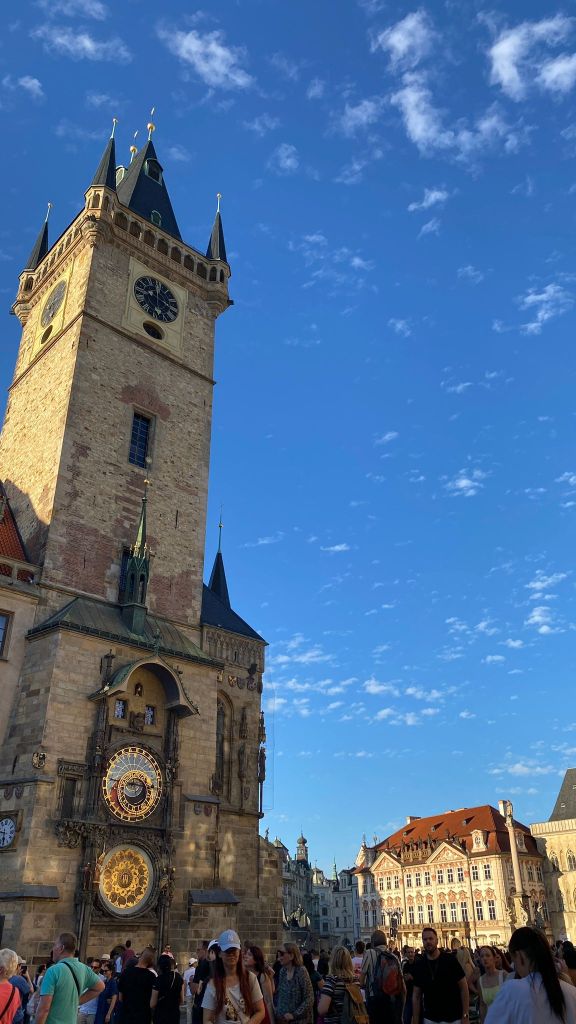
As an outdoor practitioner I am always looking for interesting ways to promote to students on how to integrate curriculum subjects in different environments. On a recent short trip to Prague I was impressed at how many learning opportunities this city has to offer. Prague offers a unique opportunity to explore subjects such as history, art, culture, religion and science combined with walking, the best form of physical activity. Prague isn’t just a city of incredible Gothic architecture, green parks and cobblestoned streets; it’s also an outdoor classroom. Crossing the Charles Bridge this Gothic stone bridge has stood for more than 650 years, connecting the Old Town with Prague Castle. As I walk its cobblestones, I’m tracing the footsteps of many who once used this route.
Two places of particular interest I visited were the National Museum, anyone curious about biology and evolution, especially those students studying GCSE/A level biology should visit the National Museum on Wenceslas Square, there is a special exhibition on Lucy and Selam. Lucy was discovered in Ethiopia, c. 3.2 million years ago, was discovered by Prof. Donald Carl Johanson in 1974 and remains one of the most important palaeoanthropological discoveries, which has contributed to our understanding of human evolution. Selam – Ethiopia, c. 3.3-3.2 million years old, was discovered by Zeresenay Alemseged in 2000. The remains of Selam are amongst the best preserved early hominin child skeletons. You can learn more about these skeletons and see the remains of the bones at the museum.
Physics in the Astronomical Clock
The Astronomical Clock in the Old Town Square is more than 600 years old, this outdoor lesson in physics integrates engineering and mechanics, watching the clock strike the hour reveals the precise movement of gears, astronomical dials, and the dance of figurines. The moving figures symbolize death, vanity, greed, and lust, all set in motion by a skeleton that rings a bell to mark the hour. This procession occurs between 8 a.m. and 11 p.m. daily.
Exploring Prague’s cultural sites will transform your sightseeing trip into a meaningful educational experience, where history, art, science and architecture become an open-air classroom.
 SG Education